
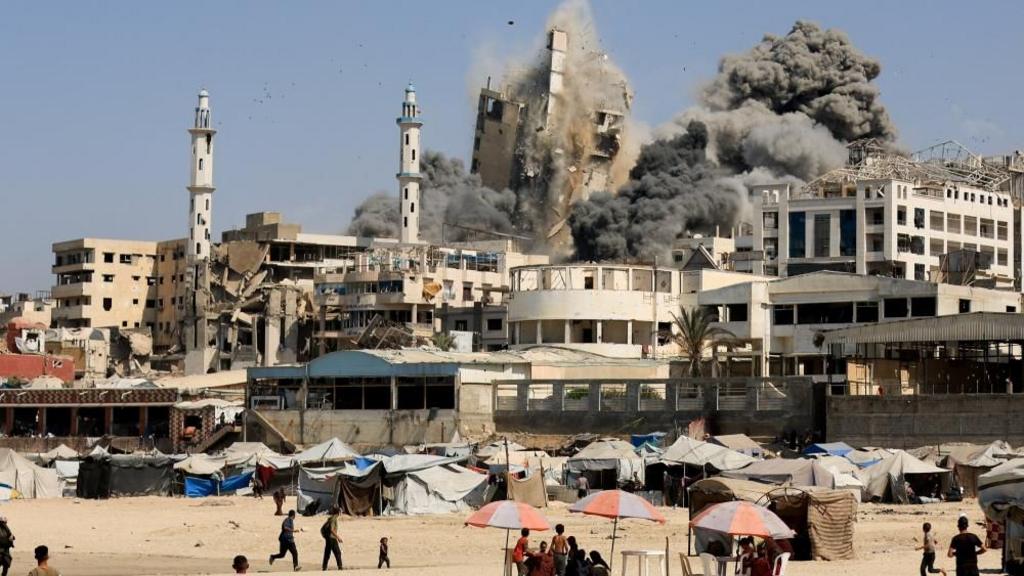
Gaza City is once again at the center of global attention as Israel launches a large-scale ground offensive that has been preceded and accompanied by relentless bombardment. The streets of Gaza, once bustling with everyday life, have now been transformed into a battlefield marked by destruction, fear, and uncertainty.
- Background to the Ground Offensive
- Life Inside Gaza During Bombardment
- Israel’s Military Strategy and Objectives
- Humanitarian Crisis in Gaza City
- International Reaction to the Offensive
- Media Coverage and Global Solidarity
- The Political Dimensions of the Offensive
- The Future of Gaza City Amid Ongoing Conflict
- FAQs
- What triggered Israel’s ground offensive in Gaza City?
- How has the bombardment affected civilians in Gaza?
- What is Israel’s stated objective in the offensive?
- How has the international community responded?
- What role do humanitarian organizations play in Gaza?
- What are the long-term consequences for Gaza City?
- Conclusion
For the more than two million residents of Gaza, the situation is nothing short of catastrophic. The intense bombardment has caused massive displacement, destroyed critical infrastructure, and deepened the humanitarian crisis that has plagued the enclave for decades. This latest escalation is not only a military confrontation but also a political and humanitarian flashpoint that is reverberating far beyond the borders of the region.
Observers say this offensive represents one of the most significant phases in the conflict between Israel and Palestinian groups in recent years. Reports from humanitarian agencies, journalists, and eyewitnesses paint a devastating picture of Gaza’s plight. As the world watches, the questions being asked are not just about military objectives but about human survival, international law, and the possibility of peace in a region long defined by cycles of violence.
Background to the Ground Offensive
The ground offensive did not emerge in isolation but was the culmination of weeks of escalating violence. After a series of rocket attacks from Gaza targeting Israeli cities and towns, Israel vowed a decisive military response. The Israeli government framed its decision to launch the offensive as a defensive necessity, aiming to dismantle Hamas’ military infrastructure, including underground tunnels, rocket-launching sites, and command centers.
Yet critics argue that Israel’s tactics, particularly the scale of airstrikes preceding the ground invasion, have disproportionately affected civilians. The United Nations has repeatedly warned about the dangers of collective punishment and the rising civilian toll. In Gaza City alone, entire neighborhoods have been flattened, leaving families trapped under rubble or fleeing with whatever possessions they can carry.
Life Inside Gaza During Bombardment
For ordinary residents of Gaza City, life has become a daily struggle for survival. Electricity blackouts are widespread, with only a few hours of power available in many areas. Water supplies have been severely disrupted, and hospitals are overwhelmed with casualties. Doctors describe scenes of chaos as they struggle to treat patients without sufficient medical supplies, many of which are restricted due to Israel’s blockade of the territory.
Eyewitness accounts reveal the psychological toll on families, especially children. Parents describe their children waking up in the middle of the night screaming from the sounds of explosions, while humanitarian workers warn that a generation is being scarred by trauma. Schools, which often serve as makeshift shelters during military escalations, are overcrowded and lack basic necessities.
Israel’s Military Strategy and Objectives
Israel has framed the ground offensive as a critical step in dismantling Hamas’ ability to wage war. Military officials point to the network of underground tunnels, often referred to as the “metro,” as a central target. These tunnels, used for storing weapons and launching surprise attacks, are seen by Israel as one of the most significant threats to its national security.
Prime Minister Benjamin Netanyahu has defended the operation by stating that Israel has the right and duty to defend itself against persistent rocket attacks. The Israeli Defense Forces (IDF) have also emphasized that they are taking measures to minimize civilian casualties, including issuing evacuation warnings before strikes. However, humanitarian groups counter that in a densely populated area like Gaza, such measures are insufficient and often impossible to implement effectively.
Humanitarian Crisis in Gaza City
The humanitarian consequences of the ground offensive are dire. According to the Palestinian Ministry of Health, thousands of people have been killed or injured in the bombardments, with a significant portion of casualties being women and children. The United Nations Office for the Coordination of Humanitarian Affairs (OCHA) has warned of an impending humanitarian catastrophe, noting that nearly half a million residents have been displaced.
Hospitals, already under strain before the escalation, are now at a breaking point. International aid agencies report severe shortages of medicine, surgical equipment, and even fuel to run hospital generators. The World Health Organization has called for safe passage for medical supplies and staff, stressing that without immediate support, thousands of lives are at risk.
International Reaction to the Offensive
The international community has been divided in its response. The United States has reaffirmed Israel’s right to self-defense while urging restraint to avoid civilian casualties. European countries have called for de-escalation and renewed efforts for a ceasefire. Meanwhile, nations in the Middle East, including Egypt, Jordan, and Qatar, have condemned Israel’s actions and pushed for urgent humanitarian interventions.
United Nations Secretary-General António Guterres has described the situation as “a grave humanitarian emergency” and urged both sides to halt the violence. Human rights organizations, including Amnesty International and Human Rights Watch, have raised concerns about possible violations of international humanitarian law, particularly regarding the proportionality of Israel’s response.
Media Coverage and Global Solidarity
The images emerging from Gaza City have sparked outrage and solidarity worldwide. Social media platforms are flooded with photos and videos of destroyed buildings, injured civilians, and grieving families. Protesters have taken to the streets in major cities, from London to New York, demanding an end to the violence and greater accountability for civilian casualties.
Journalists reporting from Gaza face enormous risks, with several media offices targeted during airstrikes. Despite these dangers, their reporting provides a critical window into the reality on the ground. Analysts argue that media coverage plays a significant role in shaping international opinion and pressuring governments to act.
The Political Dimensions of the Offensive
Beyond military calculations, the ground offensive in Gaza City also carries deep political implications. For the Israeli government, demonstrating military strength is often tied to domestic political pressures, with leaders seeking to project decisiveness in the face of security threats. For Palestinian factions, survival and resistance are equally political, symbolizing defiance against occupation and blockade.
The offensive also complicates regional diplomacy. Efforts to normalize relations between Israel and Arab states face setbacks when violence escalates in Gaza. Additionally, the offensive places international mediators, such as Egypt and Qatar, in a delicate position as they attempt to broker ceasefires while managing their own domestic and regional interests.
The Future of Gaza City Amid Ongoing Conflict
The long-term consequences for Gaza City are deeply concerning. Even if the current offensive subsides, the destruction of infrastructure, homes, and livelihoods will take years to rebuild. Experts warn that Gaza risks becoming uninhabitable if the cycle of bombardment, blockade, and humanitarian crisis continues without a sustainable political solution.
Peace advocates argue that only addressing the root causes of the conflict—such as occupation, displacement, and the lack of a viable political settlement—can prevent future escalations. Without a genuine commitment to peace, Gaza’s residents are likely to face continued cycles of violence and suffering.
FAQs
What triggered Israel’s ground offensive in Gaza City?
The offensive was triggered by escalating rocket attacks from Hamas and other militant groups targeting Israeli cities. Israel responded by launching a large-scale military campaign aimed at dismantling Hamas’ military infrastructure, including tunnels and rocket sites.
How has the bombardment affected civilians in Gaza?
The bombardment has had devastating effects on civilians, with thousands killed or injured and hundreds of thousands displaced. Basic services such as electricity, water, and healthcare have collapsed, leaving residents in dire humanitarian conditions.
What is Israel’s stated objective in the offensive?
Israel claims its objective is to destroy Hamas’ military capabilities, including tunnels and weapons storage facilities, and to restore security for its citizens who have faced repeated rocket attacks.
How has the international community responded?
Reactions have been mixed. The United States has largely supported Israel’s right to self-defense, while European nations have called for restraint. Many countries in the Middle East have condemned the offensive, and the United Nations has urged an immediate halt to hostilities.
What role do humanitarian organizations play in Gaza?
Humanitarian organizations provide critical assistance by supplying food, water, medical aid, and shelter. However, their operations are severely hindered by ongoing bombardments, restricted access, and shortages of essential supplies.
What are the long-term consequences for Gaza City?
The long-term consequences include widespread destruction of homes and infrastructure, economic collapse, and lasting psychological trauma. Without a sustainable political solution, Gaza risks remaining trapped in cycles of violence and humanitarian crises.
Conclusion
The ground offensive in Gaza City underscores the profound human and political costs of the Israeli-Palestinian conflict. While Israel pursues military objectives, the people of Gaza are paying the heaviest price, facing destruction, displacement, and despair. The international community’s divided response reflects the complexity of the crisis, but what remains clear is that without a long-term solution, the suffering will continue. Gaza City stands as a stark reminder of the urgent need for peace, accountability, and humanitarian action in one of the world’s most protracted and painful conflicts.